Cluster Pays Slots Explained Through Modern Reel Design
May 7 2026
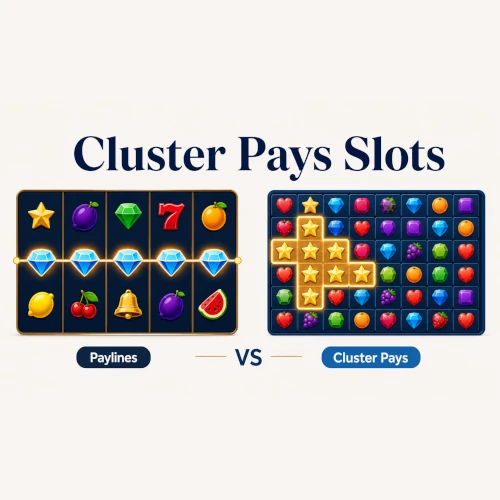
Cluster pays slots change the first thing your eyes search for. A payline game asks whether the symbols land along a fixed route. A cluster game asks whether the matching symbols gather into a connected shape. That sounds simple, but it changes the feel of every spin, because the grid becomes a space where symbols build, touch, clear, and set up features.
That visual shift matters because attention is pulled by more than bright color. Research on visual search and attention guidance explains how people scan scenes through a mix of bottom-up salience, goals, structure, and past experience. Cluster pays slots use this reading pattern: the player looks for meaningful groups first, then starts noticing how size, position, and feature symbols change the spin’s rhythm.
Seeing the Grid Before the Lines
Once the definition is clear, cluster pays become easier to understand when viewed beside current slot formats, rather than as a detached term. When you play slots at Bovada, you will see a slots page with over 1,000 slot games, including classic 3-reel titles, modern 5-reel titles, Ways Pays games, Hold & Win games, progressive jackpots, Hot Drop jackpot slots, and Bonus Buy games. That makes it a natural place to compare how different reel systems communicate results.
If you want to play slots at Bovada, read the reels with one simple question in mind: does the game reward a path, a group, or a feature trigger? Paylines teach direction. Cluster pays teach shape. Multipliers and scatters then add a second layer of attention, because they can change the value or pace of a cluster once it forms. The useful habit is to watch how the grid explains itself before focusing on theme.
A clean example is Hot Slot Spotlight featuring Gorgon’s Stash. The game is described as a 6-reel Ancient Greek slot that uses cluster pays instead of traditional paylines. It asks for 8 or more matching symbols in a cluster, then adds shield multipliers inside winning groups. Medusa scatter symbols can trigger free spins, and that bonus round introduces cumulative multipliers that carry across spins. The cluster is not only the way wins are counted, but it becomes the foundation that lets multipliers, symbols, and bonus pacing work together.
Cluster Pays vs Paylines Without the Jargon
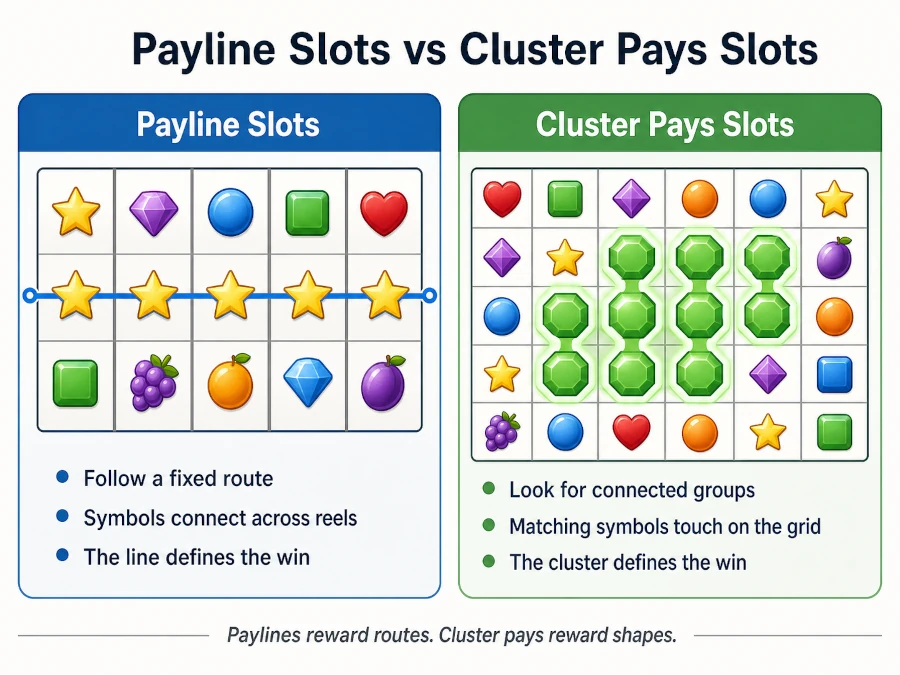
A traditional payline is a route across the reels. It may be straight, angled, zigzagged, or shaped in another preset way, but the result depends on whether the right symbols land along that route. A cluster pay system removes that line-first reading habit. Instead, it looks for enough matching symbols touching one another on the grid, usually horizontally or vertically, depending on the game’s rules.
| Feature |
Payline Slots |
Cluster Pays Slots |
| Main reading habit |
Follow preset routes |
Look for connected groups |
| Visual focus |
Alignment across reels |
Symbol density on the grid |
| Spin feel |
Direct and line-based |
Spatial and pattern-based |
| Feature pairing |
Wilds, scatters, bonus lines |
Cascades, multipliers, free spins |
This is why cluster pays can feel more modern. The player is not only checking whether a line has been completed. They are watching the screen for density. A small patch of matching symbols can feel close to becoming something larger. A bigger grid gives that tension more room. If cascading reels are involved, one cluster can clear space and allow new symbols to fall, creating a sequence, rather than a single stop.
Why Multipliers Fit the Format So Well
Multipliers are easier to understand when the slot clearly shows what they attach to. In a line-based game, a multiplier may apply to one line win, one wild, or one bonus event. In a cluster game, it can feel more intuitive because the winning group is visible as a shape. If a shield, gem, coin, or special symbol lands inside that group, the player can see why the feature matters.
That is the design strength of cluster pays. The mechanic turns math into a visual event. A group forms. A feature symbol connects to it. The reel presentation explains the moment with motion, sound, and highlighting. The best versions make the result readable without needing the paytable open every few seconds.
Theme also helps. A mythological slot can create a multiplier in the shape of a shield, spell, or artifact instead of a plain number. A treasure slot can make clusters feel like gathered gems. The mechanic stays the same, but the story gives the grid a clearer personality.
The Takeaway for Beginners
Cluster pays slots are not harder than paylines. They simply ask for a different kind of attention. Instead of tracing lines, you read the grid for groups. Instead of treating every spin as a flat result, you notice whether the game builds movement through clusters, multipliers, scatters, and free spins.
For beginners, the most useful question is not “which format is better?” It is “which format is clearer to me while I watch it?” Paylines reward route-reading. Cluster pays reward shape-reading. Both can be enjoyable, but cluster pays stand out when modern reel design makes the grid feel active, readable, and visually connected from one moment to the next. That connection between fast visual scanning and game structure is also why research on visual attention across video game genres is a useful background for understanding how players read busy screens.
« BACK




 Betsson Casino

 22Bet Casino
 Stake Casino
 Betsafe Casino
 Winz.io Casino

 Videoslots Casino
 Fastpay Casino
 National Casino
 Betlabel
 22Casino